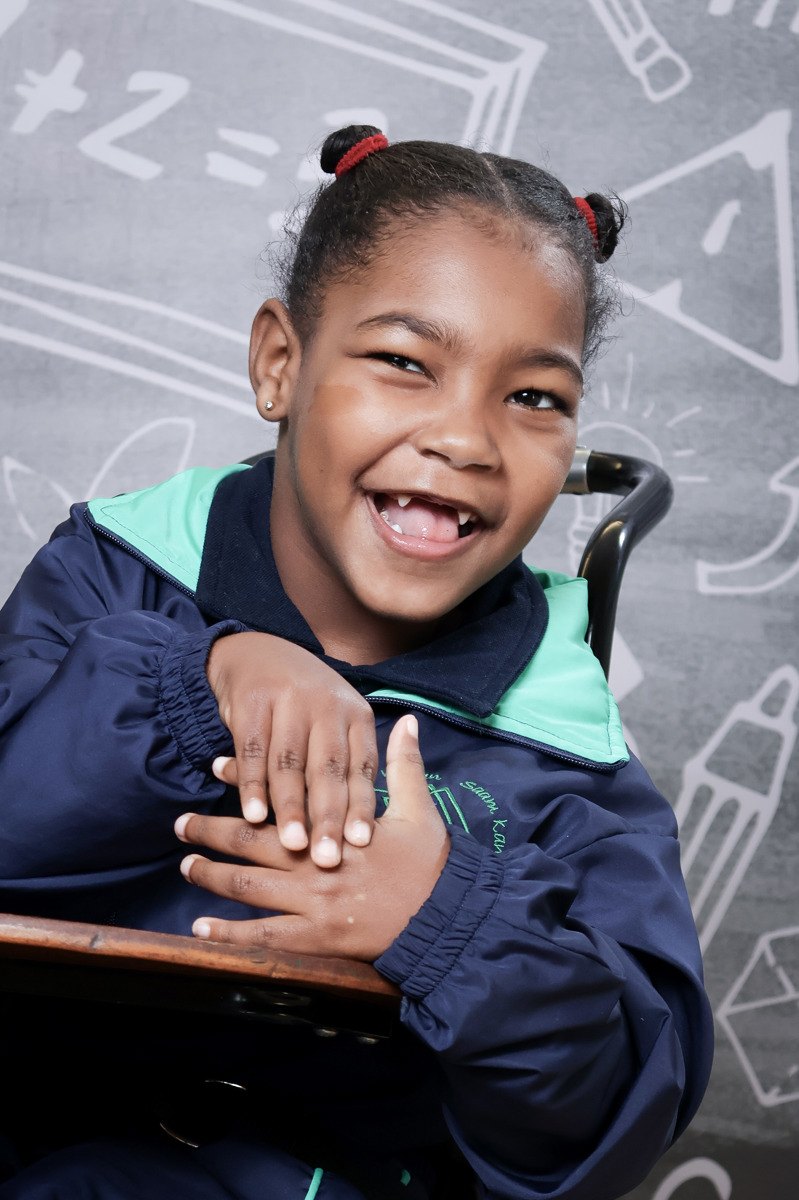
For Caitlin Johannes, a motorised wheelchair could mean more than movement—it could create new choices at school and in everyday life.
Caitlin is a learner at Cheré Botha Special School in Cape Town. The school supports children with high support needs, including learners with physical disabilities, autism spectrum disorder and intellectual disabilities. Its history began more than 30 years ago when parents could not find appropriate schooling for their daughter with Down syndrome. Today the school serves about 330 learners. Government departments assist with devices where possible, but available funding is limited and stretched across many needs. Motorised wheelchairs are therefore difficult to secure, while many families cannot afford to purchase one privately.
Independent movement changes daily choices
A manual wheelchair can provide essential mobility while still requiring another person to push, especially across longer distances or uneven spaces. A powered chair can allow a learner to decide where to move and when, within the limits of a safe and accessible environment. That difference can affect participation in class, movement between activities and social interaction. Independence is not only about travelling farther; it is about having more control over ordinary decisions.
The school sees needs that funding cannot always meet
Cheré Botha’s staff work in an environment where assistive technology can transform a learner’s experience, yet each device carries a significant cost. Public systems must prioritise across many children, and the most suitable option is not always funded.
The campaign for Caitlin creates a direct route for donors to help meet one specific mobility need. It does not replace the broader responsibility to make education accessible, but it can change one learner’s daily reality.
A wheelchair must fit the person and environment
A motorised wheelchair is not a one-size-fits-all purchase. Seating, controls, size, posture support and the spaces where it will be used all matter. Clinical and technical assessment should guide the final device. That makes the live campaign and school’s confirmed requirements essential before purchase. Fundraising creates the financial possibility; professionals and Caitlin’s support team help ensure the result is appropriate and safe.
The wider impact
Assistive technology is sometimes described only in terms of equipment, but its real value lies in participation. The right device can reduce dependence, conserve energy and help a learner engage more fully with education and relationships.
Caitlin’s campaign also shines a light on the gap between what schools know would help and what limited budgets can provide. A successful fundraiser can meet an immediate need while encouraging wider conversations about inclusive design and equitable access.
The story should remain centred on Caitlin’s agency rather than presenting mobility as a symbol. The chair is a tool; the goal is greater choice, access and independence on her own terms.
A motorised wheelchair is not simply a faster version of existing equipment. When it is properly assessed and fitted, it can reduce dependence on someone else for every movement, make everyday spaces easier to navigate and conserve energy for school, relationships and the activities Caitlin enjoys. The right chair must also match her posture, support needs and environment, so the campaign is tied to a practical piece of assistive technology rather than a general wish. Independence will still look different from day to day, but having reliable control over movement can expand choice in small, meaningful ways. That is why fundraising for equipment can have an impact long after the handover itself.
What support can make possible
Funds are being raised for a suitable motorised wheelchair. Confirm the final specification, quote and campaign status on the live page before publication.
- Powered mobility suited to Caitlin’s needs
- Greater independence moving around school and daily environments
- Reduced reliance on others for every change of position or destination
Supporters can donate or share the campaign with disability organisations, equipment specialists and potential sponsors. Any partnership should follow the school and family’s guidance and protect Caitlin’s privacy.
Follow Caitlin’s motorised wheelchair campaign
https://www.backabuddy.co.za/campaign/help-caitlin-get-her-motorised-wheelchair