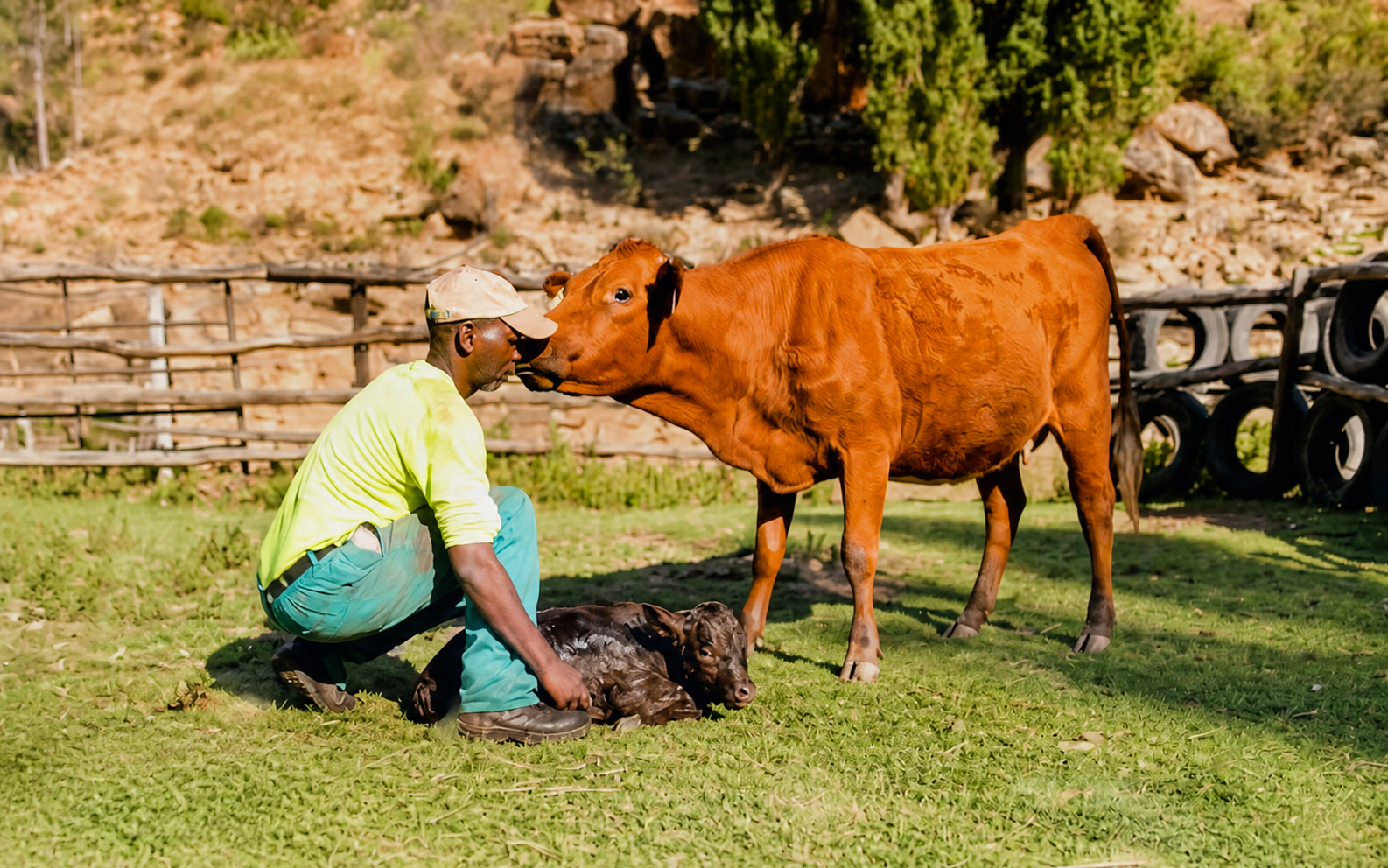
James Calata, Eastern Cape — Sixty-two-year-old farmer Simosakhe Hleko has spent 18 years building a livestock and lucerne operation on Mooivlei, a 743-hectare farm in the Joe Gqabi District, after beginning his working life as a farm labourer with no formal education. Now, amid uncertainty over the land’s future, his daughter is trying to raise R5 million so the family can secure the farm he has spent nearly two decades developing.
Hleko’s farming journey stretches back more than 40 years. Born to farmworker parents in 1964, he began working on farms at 14 and used his wages to buy his first livestock in 1984, when he was 20.
Over the decades that followed, he built a commercial farming operation spanning cattle, sheep and lucerne production. His family says his livestock eventually grew to nearly 600 animals, even though he never secured permanent ownership of the land needed to expand with certainty.
His daughter, Nolusindiso Hleko, has now launched Help My Father Buy the Land He’s Farmed for 18 Years on BackaBuddy. The campaign has raised R4,519 from 31 donors in its first three weeks.
“This is my father, Simosakhe Hleko,” she says. “Farming is all he knows. He knows every corner of Mooivlei like the back of his hand.”
A Farming Story More Than Four Decades in the Making
Support this campaign: View Help My Father Buy the Land He’s Farmed for 18 Years and share this story with your community.
Simosakhe’s story did not begin with land, finance or inherited farming infrastructure.
It began with wages earned as a young farmworker.
By 20, he had saved enough to buy his first livestock and began slowly building a herd. Without land of his own, however, keeping and expanding those animals became an ongoing challenge.
His family says he moved livestock between six different properties over the years while searching for somewhere more permanent.
In 2008, he reached an arrangement that allowed him to keep most of his animals at Mooivlei. Eleven years later, he left his salaried job and committed himself to farming the property full-time.
By then, he was supporting a wife and five children while earning less than R5,000 a month, according to the family.
Moving to Mooivlei meant betting his future on farming.
Building a Commercial Operation on the Mooivlei Farm
When Simosakhe took on Mooivlei, his family said significant work was needed to improve its agricultural potential.
Over time, he invested his own labour and money into fencing, irrigation, arable land and lucerne production while continuing to grow the livestock operation.
Today, official property information records Mooivlei at approximately 743 hectares, including about 699 hectares of natural grazing, 17 hectares of flood irrigation and 27 hectares of arable dryland.
By 2025, the Hleko farming business was generating income from cattle, sheep and lucerne.
The cattle operation was selling around 50 weaners annually into commercial markets, while the sheep enterprise produced wool for established buyers and marketing agents. Lucerne grown on the farm also provided feed and an additional income stream through sales to neighbouring farmers.
The business had become substantial enough for land ownership to be identified as one of the main obstacles to its long-term security.
For Simosakhe, that uncertainty has followed him throughout much of his farming career.
Decades of Trying to Secure Land
According to his daughter, Simosakhe first approached the Department of Land Reform and Rural Development for assistance in acquiring land in 2003, but his application was unsuccessful.
He tried again in 2013.
The family says that application was also unsuccessful, leaving him with livestock and a growing farming operation but no permanent land of his own.
He nevertheless continued building the business at Mooivlei.
In 2024, Simosakhe again approached the department about formally securing the property. Mooivlei subsequently entered a formal state-land lease application process, and departmental records from December 2025 list the property as agricultural land available through the department’s beneficiary selection and land allocation programme.
The family says Simosakhe submitted the required application in December 2025 but remains uncertain about whether he will ultimately secure the farm.
Rather than continue waiting without certainty, his children are now exploring another possibility: raising enough money to secure Mooivlei for their father themselves.
Farming Has Become a Family Legacy
What Simosakhe built has already begun moving into a second generation.
His son, Vuyolwethu Hleko, pursued formal agricultural studies in animal production and became involved in the farming business.
That combination of Simosakhe’s decades of practical knowledge and his son’s agricultural training has allowed the operation to develop beyond one man’s livelihood.
It is increasingly a family agricultural business with the potential to continue after Simosakhe eventually steps back.
That possibility is one reason land security matters so deeply to the family.
Without permanent access to the farm, decades of infrastructure, production knowledge, business relationships and future plans remain tied to land they do not own.
For Nolusindiso, helping her father secure Mooivlei would therefore protect more than his retirement.
It would protect something he built for the generation after him.
A Daughter’s R5 Million Mission
Nolusindiso is seeking R5 million through BackaBuddy, while also sharing her father’s story internationally in the hope of reaching individuals, agricultural organisations and potential supporters who understand what long-term land security could mean for the family.
The campaign remains in its early stages, with 29 donors contributing R4,519 so far.
Some supporters have donated R50 or R100, while others have contributed larger amounts. Support has even arrived from overseas.
“We believe in you and your family’s dream all the way from the Netherlands,” one donor wrote.
Another supporter said Nolusindiso’s determination to help her father was what prompted her to contribute.
For the Hleko family, reaching R5 million will require the story to travel far beyond the people who already know them.
But they are beginning in much the same way Simosakhe began his farming journey more than four decades ago: with something small and a willingness to keep building.
“Helping him keep Mooivlei wouldn’t just solve a crisis,” Nolusindiso says. “It would be full circle, the ultimate retirement gift for a man who has spent his whole life giving everything to the land.”
Support this campaign: Support Help My Father Buy the Land He’s Farmed for 18 Years on BackaBuddy.
How Community Support Can Help Secure the Mooivlei Farm
Support for the Mooivlei farm can help protect the family’s livestock operation and the farming legacy Simosakhe has built over decades.